About Me

My photo
im Jaded..i create this blog to share my little knowledge about what i've been taken from my college life and my greatest frustration in life is to develop my own accounting software..

Sunday, August 21, 2011

Case Study: Design House Partnership


Questions:

1.      Why is operations management important in CDS?

Being a service provider company CDS should ensure that business is operating efficiently in terms of using a little resources as needed (cost savings) and effective in terms of meeting customer requirements. To be able to achieve this objective, the company should have an operations manager which will be in charged of the day –to-day operations of the company. Operations management is an area of management concerned with overseeing the operations of the company and meeting customer requirements at a lower cost.
Operations management is important so that the company knows where it is going, what are its goals, and objectives.

2.      What would you recommend to the company if you were asked to advice on improving its operations?
To improve its operations, the company should be able to address the challenges they have identified namely:

A.       The relationship between the design department and the other department in the company.
In order to meet the customer requirements at a reasonable time people inside the company, especially those departments that need to work together, should have harmonious relationship. This is important so that work will flow smoothly, delay due to miscommunication will be minimized or eradicated, and people will be motivated to work because of good working relationship with each co-employee.  Moreover, if there is good working relationship, then ideas could flow freely which will be beneficial to the company.
Relationship of each employee with one another is very important to every organization.  No matter how good the operations management of the company is, if the employees do not have good working relationship, then the company will not be able to improve its operations.  Team building helps build good working relationship among employees.

      B.      Sales Forecasting

The company should devise a way in order to improve sales forecasting the following week so that manufacturing and distributions operations will not be disrupted tremendously.


Recording Partners Investment

Investment by partners may be made in the form of cash or others asset as provided in the partnership contract. When assets other than cash are invested, it is necessary for the partners to agree upon the value such assets. The assets record in accordance with the agreement, and the capital accounts are credited for the amount of the respective investment.

The importance of proper valuation of asset invested by partners cannot be overemphasized. The values originally assigned to asset are credit to to the partners investing the assets and become measurement of his assets; subsequent sales of these assets at amount other than book value result in profits and loss item that are divided in the profits and loss ratio. If equity is to be achieved; then, assets invested by partners should be reported at their fair market value; only increases or decreases in the value of such assets taking place during the term of partnership will be allocated among the partners. 

Friday, August 19, 2011

Jose Rizal Qoutes

Rizal on his aged..

"Kabataan ang pag-asa ng bayan"

 After Rizal die, modern filipino change to:

"Kabataan ang Bayan!

Thursday, August 18, 2011

Class of Stock and Terms

A corporation may issue two classes of stock, one is Common Stock, second is the Preferred Stock. When a single class of stock is issued, the stock is called common stock.

Commonn Stock are the ordinary stock of a corporation that entitles the owner to a pro rata share of the dividends without having priority or preference over any others stockholders or class of stockholders. A corporation may issue more than one class of stock. They may be identified as class A, class B and class F. in Philippines setting class A stock may be owned by filipino citizen only, while class B stock maybe owned both foreign and filipino.  

Preferred Stock are stock that are given certain preferences over common stock. These preferences may be: 

1. Preferred as to dividends
2. Preferred as to assets in case of liquidation

Term of Capital Stock

1. Authorized capital stock is a total amount or the numbers of share that a corporation is authorized by law to sell or to issue as state in the article of incorporation. This may be increase or decrease by making amendments to the articles of the incorporation.

2. Unissued Capital Stock is the amount of capital stock that remain unissued.

3. Subscribed Capital Stock  is the amount of shares contracted to be purchased and paid by subcribers.

4. Outstanding Capital Stock is the amount of shares issued and in the hands of stockholders.
5. Treasury Stock is the corporation own stock that has been issued and reacquired by the corporation but not calcelled.

6. Capital Stock Issued is the total amount of shares that is put into circulation or issued by a corporation. This consist of outstanding and treasury stock.

Contituents of a Corporation

The following are the constituents of the corporation.

1. Incorporators  are the members or stockholders or both mentioned in the articles of incorporation as originally forming and composing the corporation.

2. Corporators are those who compose the corporation, whether they be stockholders or members. The terms includes incorporators, stockholders, or members. All incorporators are corporators in as much they are stockholders or member of a corporation. But a corporators is not necessarily incorporators. Although they maybe a stockholders or members  of the corporation, They may not be the one of those who formed and form the corporation. 

3. Stockholders are corporators of a corporation who own at least one share of the corporation capital stock.

4. Members are corporators of a corporation, which has no capital stock.

Merchandise Inventory

The inventory of a merchandising entity consist of goods purchased for resale. For a grocery store, inventory would be made up of meats, vegetables, canned goods, soft drinks and others items. For a lumber hardware it would be plywood, paints, nails, iron sheets, cements, tools, and other items. Merchandising entities purchased their inventories from manufacturers, wholesalers, and other suppliers.

The merchandise inventory at the beginning of the accounting period is called beginning inventory. Conversely, the merchandise inventory at the accounting period is called ending inventory. Beginning and ending inventories are used in calculating cost of good sold in the income statement. The ending inventory shown in the income statement will be the the merchandise inventory to be reported in  the balance sheet. Effectively, the ending inventory of the current period will be the beginning inventory of the next period.

Game plan Marketing Solution Inc
Partial Income Statement
For the Year ended Dec 31, 2011

Cost of Good Sold
Merchandise inventory beginning Jan. 01 2011                                          528,000.00
Add:
Purchased                                                                    790,000.00
Transportation In                                                            80,000.00             870,000.00
Goods Available for sale                                                                      1,398,000.00 

Less: Ending Inventory Dec. 31 2011                                                        990,000.00

Cost of Good Sold                                                                                   408,000.00


Wednesday, August 17, 2011

Accounting Process Cycle

The accounting process cycle refers to a series of sequential steps or procedures performed to accomplish  the accounting process. The steps in the cycle and their aims follow:

                                      Step 1   Identification of events to be Recorded
                                                    This is to gathered information about transaction or events
                                                    generally through  the source of document.

This is during the           Step 2   Transaction are Recorded in the Journal
accounting period                         This is to record the economic impact of transactions on the firm in a
                                                     journal, which is a form that facilitates transfer to the accounts.    

                                   
  -----------------------       Step 3    Journal Entries are Posted to the Ledger
                                                     This is to transfer the information from the journal to the ledger for
                                                     classification.


                                      Step 4   Preparation of Trial Balance
                                                    This is to provide a listing to verify the equality of debit and
                                                    credits in the ledger.


                                      Step 5   Preparation of the Worksheet include Adjusting entries
                                                    This is to aid in the preparation of financial statement.


                                      Step 6   Preparation of Financial Statement
                                                    This is to provide useful information to decision makers.
This is at the
end of accounting          Step 7   Adjusting Journal Entries are Journalized and Posted
period                                           This is to record the accruals, expiration of deferrals, estimation and other
                                                     transaction from the worksheet.


                                      Step 8   Closing Journal Entries are Journalized and Posted
                                                    This is to close temporary accounts and transfer net income to owner
                                                    equity.

----------------------           Step 9    Preparation of a Post-Closing Trial Balance
                                                     This is to check the qualify of debits and credits after the closing entries. 

This is the                      Step 10   Reversing Journal Entries are Journalized and Posted
start of the                                    This is to simplify the recording of certain regular transaction in the next
next period                                    accounting period.


This cycle is repeated each accounting period. The first three steps in the accounting process are accomplish during the period. The fourth up to nine steps generally occurs at the end of he period. The last step is optional and occurs at the beginning of the next accounting period.


Deferrals and Accruals

Deferral is the postponement of the recognition of "an expense already paid but not yet incurred," or of "a revenue already collected but not yet earned". This adjustment deals with an amount already recorded in a balance sheet account; the entry, in affect, decrease the balance sheet account and increase the income statement account.Deferrals would be needed in two cases:

1. Allocating assets to expense to reflect expenses incurred during the accounting period. (e.g prepaid insurance, supplies and depreciation).

2. Allocating revenues received in advance to revenue to reflect revenues earned during  the accounting period.(e.g subscription)


Accrual is the recognition of "an expense already incurred but unpaid" or revenue earned but not collected". This adjustment deals with an amount unrecorded in any account; the entry, in effect, increase both a balance sheet and  an income statement  account. Accruals would be required to cases:

1. Accruing expenses to reflect expenses incurred during the accounting period that are unpaid and unrecorded.
2. Accruing revenue  to reflect revenue earned during the accounting period that are uncollected and unrecorded.

Tuesday, August 16, 2011

Comparison of Income between Service and Merchandise Company

Service companies perform service for fee. In ascertaining net income, a basic income statement is all that is need. Net income is measured as the difference between revenues from services and expense. In contrast, merchandising companies earn income by buying and selling goods. These entities use the same basic accounting methods as service companies, but the process of buying and selling merchandise required some additional accounts and concepts. This process result in a more complex. To provide a better measurement of performance, the income of merchandising business is presented with additional line items:


                     Service Company                                               Merchandising Company
                      Income Statement                                                        Income Statement


                          Revenues                                                                      Net Sales
                                                                                                                 minus
                                                                                                      Cost of Good Sold
                             minus                                                                          equals
                                                                                                    Gross Margin from Sales                 
                                                                                                                 minus
                         Expenses                                                                Operating Expenses
                           equals                                                                           equals
                       Net Income                                                                    Net Income


This is the difference of components between service company and merchandising company.


Operating Cycle of a Merchandising Business

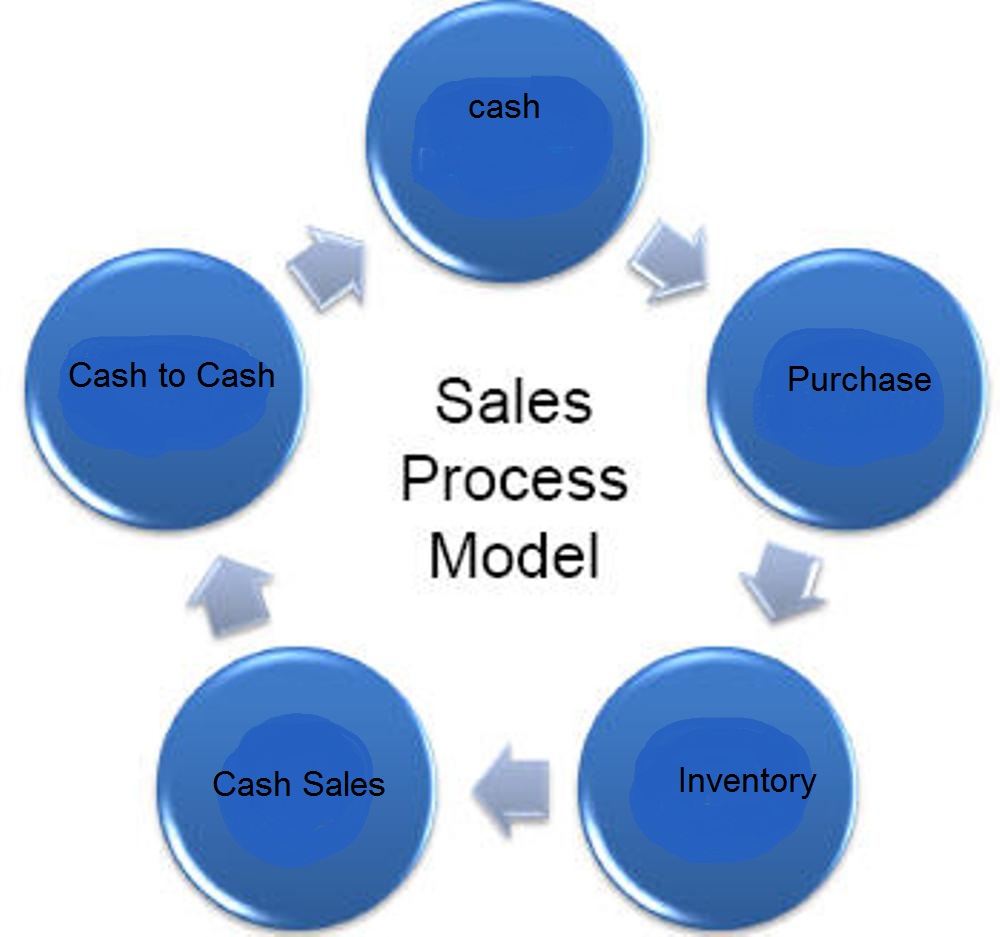
The merchandising entity purchases inventory , sells the inventory and uses the cash to purchase more inventory- and cycle continues. For Cash Sales, the cycle is from cash to inventory and back to cash. For sales on account, the cycle is from cash to inventory to accounts receivable and back to cash. In any industry, manager strives shorten the cycle. The faster sale of inventory and the collection of cash, the higher the profits. The following illustration the operating of a merchandising company.


     Sales on Account                                                                                                 Cash Sales


Sales on Account